This could be a 20 million dollar business.
| This document is a work in progress. |
Overview
This document seeks to define & encompass all components (and their nuance) regarding Project PAIN 2026.
-
Woah👀…sounds serious. What is Project PAIN?
-
Project PAIN is just a code name & catchall term for all SMB related efforts:
-
Ultimately the goal is to launch into the SMB market with new product lines that are self sustaining, with recurring revenue models that can scale (i.e. not trading time for money on every transaction).
Content Marketing Strategy
Our mission is to position Report Factory as the definitive authority on how to build resilient, scalable, and future-proof businesses and reporting systems. In other words, where Aqueducts Consulting (and ConduitBI) focus on selling artifacts & services--this initiative will focus on selling information & education.
1. Core Psychological Positioning
-
Every company must treat reporting as an “insurance policy” against key-person risk and system failure.
-
Reporting is not an ad-hoc task – it is a production system that must always deliver.
-
We sell a future-based cause—no company should ever lose access to the information it depends on—or the means by which they access it.
-
Positioning emphasizes protection and continuity—reporting systems are vulnerable to loss of key personnel ("What if you lost that person?"), making backup and documentation essential for business resilience.
-
The core fear addressed is disruption from "rainy days"—unexpected events like employee departure—positioned as preventable through proactive measures.
-
The promise is reliability and peace of mind—systems that are repeatable, backed up, and transferable, ensuring no report system ever fails.
2. Adopted Principles
-
We’re not going after the sophisticated buyers.
-
Target audience is the unsophisticated or anxious buyer: Small to mid-sized business owners who feel "size anxiety" around corporate reporting, associate it with complex tools like SAP/Oracle, and fear feeling "stupid."
-
Sophisticated buyers represent only 1% of the market, often believe they already know everything, and are harder to reach.
-
Focus on relatable, non-intimidating entry points that allow prospects to "sit there in front of the ad" without discomfort.
-
Marketing prioritizes empathy and accessibility over technical impressiveness.
3. Content Considerations
3.1. First Encounter
-
Prospects must feel comfortable engaging with initial ads: "Can I sit there in front of this guy and not feel like I’m stupid?"
-
Initial exposure (e.g., Facebook ads) should rapidly signal relevance and safety for non-experts.
-
Hook centers on common pain: Informal or single-person reporting setups vulnerable to loss ("What if something happens to them, and you can’t get reports out anymore?").
-
Positioning as "Rainy Day" insurance: Backup and documentation to mitigate key-person risk.
-
Short ads (30 seconds) introduce the problem and fear; longer content (2–5 minutes) explains solutions.
-
Immediate pathways for urgency: Links for "triage cases" needing reports immediately, directing to emergency services like Report Crusher or one-on-one support.
-
Content funnels prospects into the ecosystem by telegraphing multiple product lines (Rainy Day backup, Report Crusher onboarding, one-on-one/custom help) based on urgency and sophistication level.
-
Psychological goal: Build trust quickly, reduce intimidation, and provide clear next steps tailored to the prospect’s current pain (prevention, immediate help, or system building).
3.2. Overall Marketing Funnel and Psychological Flow
-
Entry via low-barrier, self-liquidating offers (e.g., Rainy Day as prerecorded course with certification) to acquire customers at near-zero cost.
-
Upsell stacking: Higher-tier products include lower ones (e.g., Report Crusher includes Rainy Day; Report Factory Workshop includes both), creating perceived massive value.
-
Progressive positioning:
-
Rainy Day: Backup and documentation focus—appeals to those who have something to protect (including "smart suburbanites" who handle most things themselves but need insurance).
-
Report Crusher: Live, energetic onboarding—targets beginners needing reports done now, intermediates seeking repeatability, and advanced users refining methods; positions as high-energy, community-driven value.
-
Report Factory Workshop: System-building for failure-proof reporting—targets those ready to implement enterprise-level processes with handholding.
-
-
Cross-promotion within content: Each product advertises the others, creating seamless ascension (e.g., Rainy Day ends with pitch to Report Crusher for implementation).
-
Psychological progression: From fear alleviation (backup against loss) → empowerment (getting reports done) → mastery (building unbreakable systems).
-
Long-term ecosystem building: Certifications, handouts, blueprints, and community contributions create ongoing engagement and lead generation for custom/franchise services.
4. Content Types
| Our organic content will work in concert with our ads to drive traffic into our marketing funnels. |
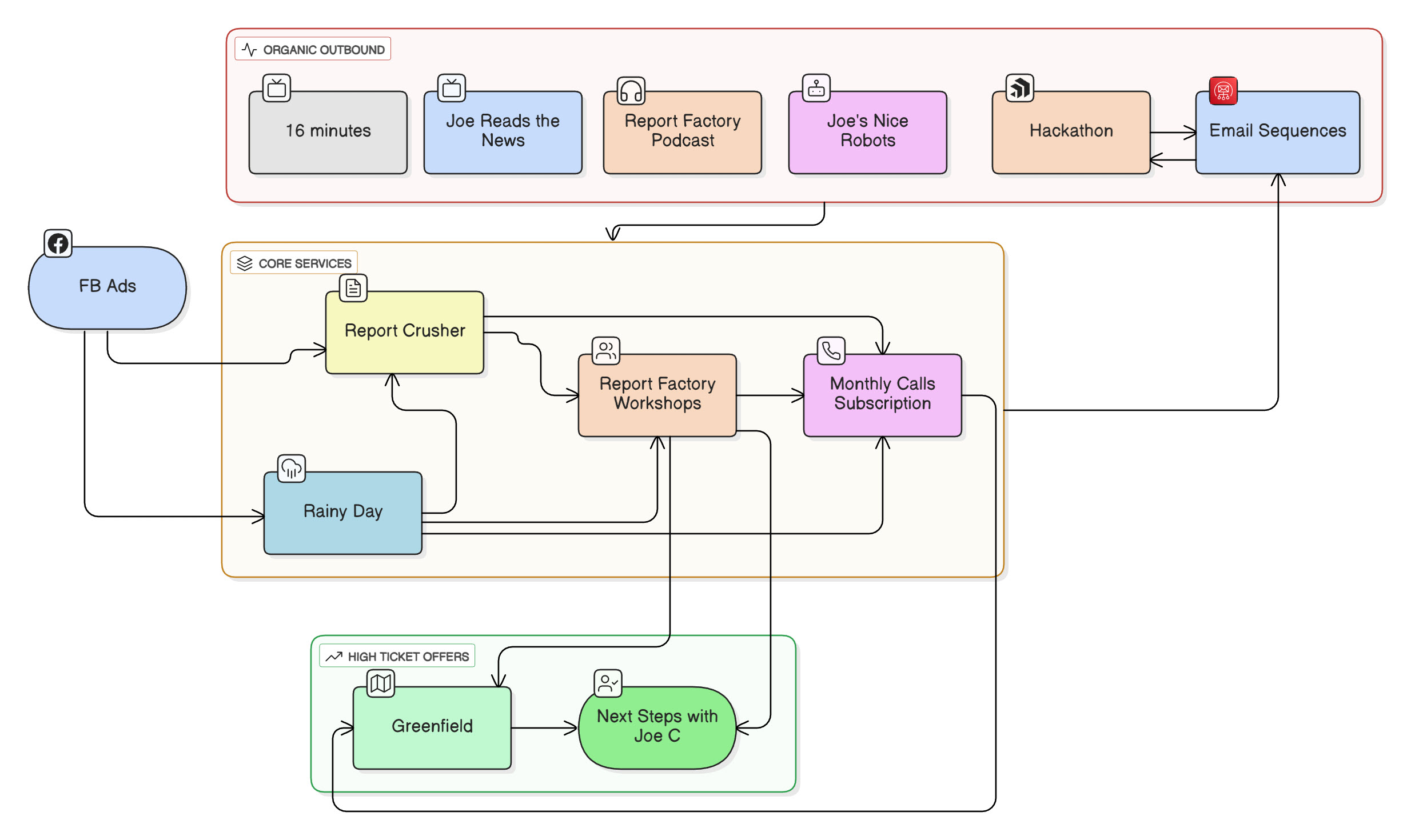
4.1. Hackathon
4.1.1. Definition
-
TODO
4.1.2. Comprised of
-
a
-
b
-
c
4.1.3. How we will build it
4.2. Joe Reads the News
4.2.1. Definition
-
Joe adopts a mild mannered reporter persona and reads his LinkedIn newsfeed Live to the masses, peppering the audience with wit & humor
4.2.2. Comprised of
-
weekly occurence (every Friday @ 0930 CST)
-
Joe
-
Restream
-
social post (clips)
-
LinkedIn Group
-
Newsletter
4.2.3. How we will build it
4.3. Report Factory Podcast
4.3.1. Definition
4.3.2. Comprised of
4.3.3. How we will build it
Interview-style show (virtual or in-person Dallas/Irving street interviews):
-
Business owners/managers discuss their reporting pain
-
Live mini-consult + prescription (always starts with Rainy Day → Crusher → Community)
-
High entertainment value, street journalism format
4.4. 16-Minutes (F&O)
4.4.1. Definition
-
Couldn’t afford 60 -
investigative journalism (dave letterman / john stewart / john oliver)
4.4.2. Comprised of
4.4.3. How we will build it
30–60 minute technical tutorials and case studies (data lakes, Microsoft Fabric, AI agents + reporting, etc.) optimised for SEO and YouTube algorithm.
4.5. Joe’s Nice Robots
4.5.1. Definition
4.5.2. Comprised of
4.5.3. How we will build it
15–90 second clips from all longer content + original hooks, memes, and quick tips.
4.6. Email Sequences
4.6.1. Definition
4.6.2. Comprised of
-
Our Business logic
-
Mailbluster (our email marketing tool that manages our list)
-
Our platform (the actual monolithic app that will run on our server)
4.6.3. How we will build it
Automated Email & Newsletter Upsell/Cross-sell Strategy
Free Plan Flow (The Welcome Sequence)
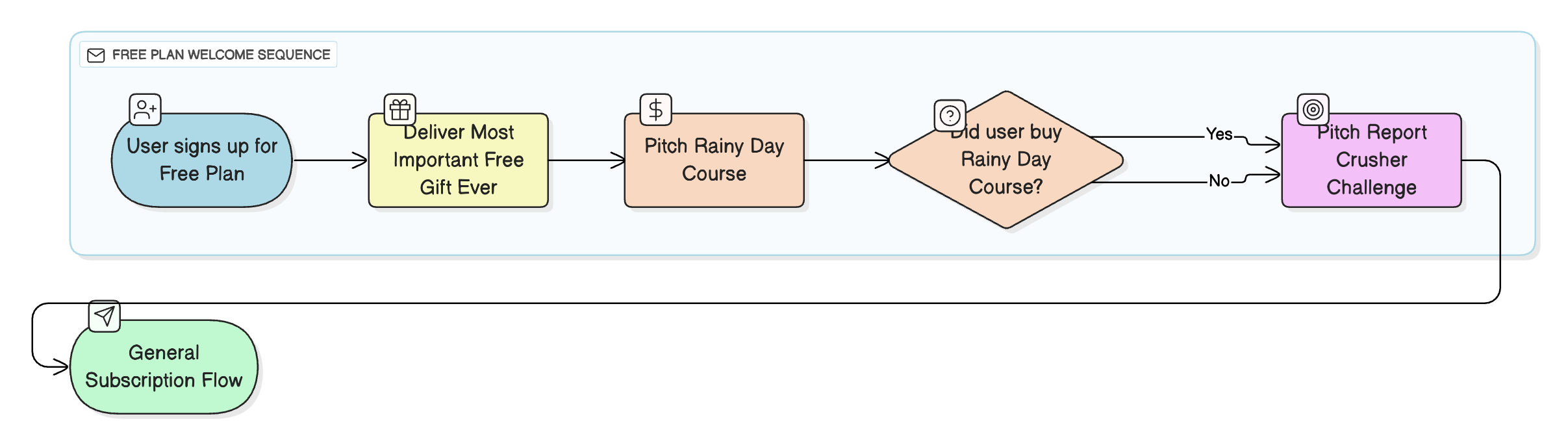
| By default any prospect that creates an account on our platform will be on the Free Plan / have access to the MIFGE |
-
Purpose: To deliver on a promise and immediately introduce the first paid tier.
START: User signs up for the Free Plan.
STEP 1: Deliver the "MIFGE" (Most Important Free Gift Ever).
STEP 2: Pitch the "Rainy Day Course."
DECISION: Did they buy Rainy Day? IF YES: Proceed to next challenge. IF NO: Skip to next challenge.
STEP 3: Pitch the "Report Crusher Challenge."
END: Move user into the General Subscription Flow.
Subscription Flow (The Nurture & High-Ticket Sequence)
-
Purpose: To onboard active members and upsell professional services.
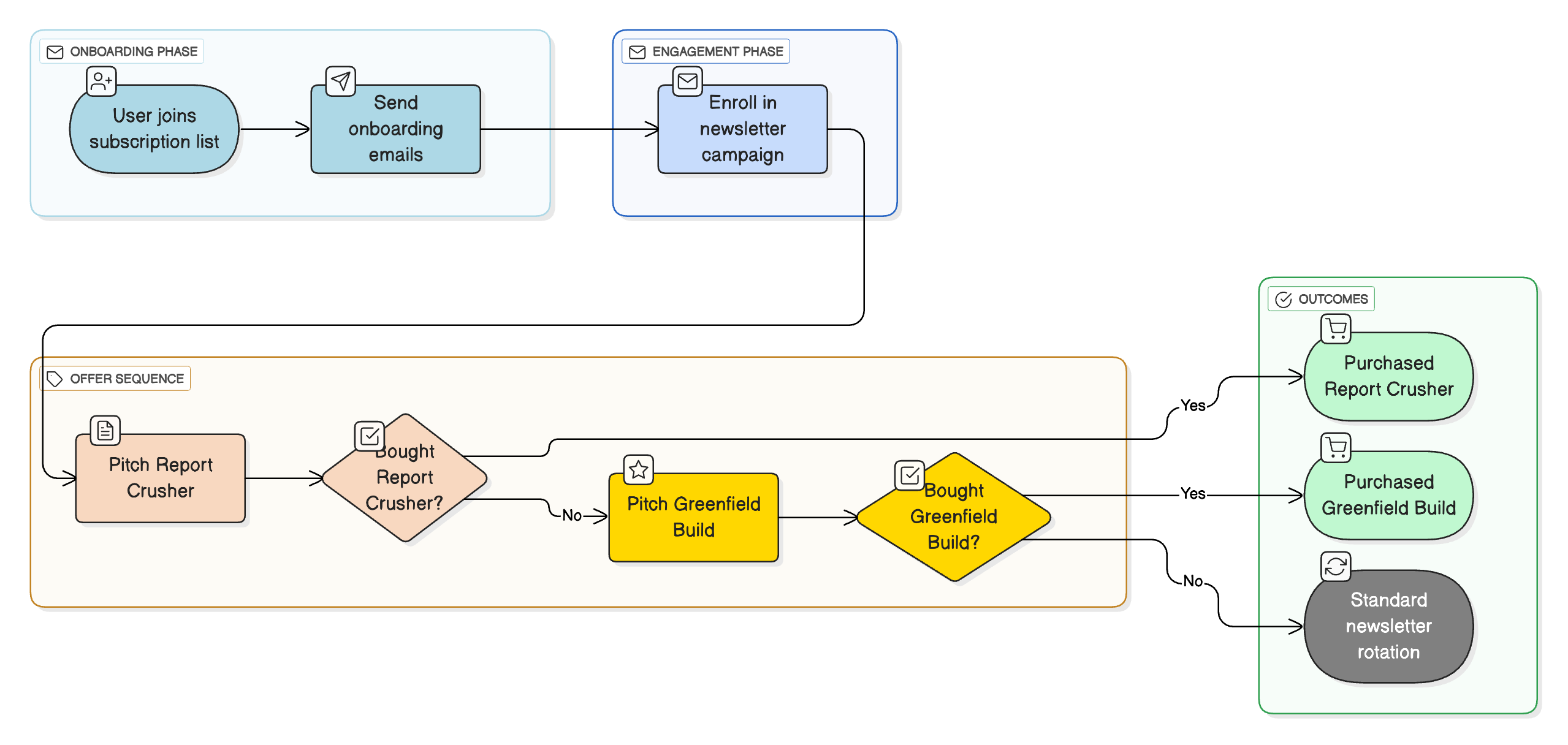
START: User joins the subscription list.
STEP 1: Send Onboarding Emails (Introduction and setup).
STEP 2: Enroll in the regular Newsletter Campaign.
STEP 3: Pitch "Report Crusher."
DECISION: Did they buy Report Crusher? IF YES: Finish flow. IF NO: Present high-tier offer.
STEP 4: Pitch "Greenfield Build" (High-ticket/Premium service).
DECISION: Did they buy Greenfield? IF YES: Record sale and finish. IF NO: Finish.
END: User remains in standard newsletter rotation.
Bought [rainy-day] only
Bought [report-crusher] only
Lapsed Customer Flow (The Winback Sequence)
-
Purpose: To re-engage "lost" users or downsell them if they aren’t ready to return to a full subscription.
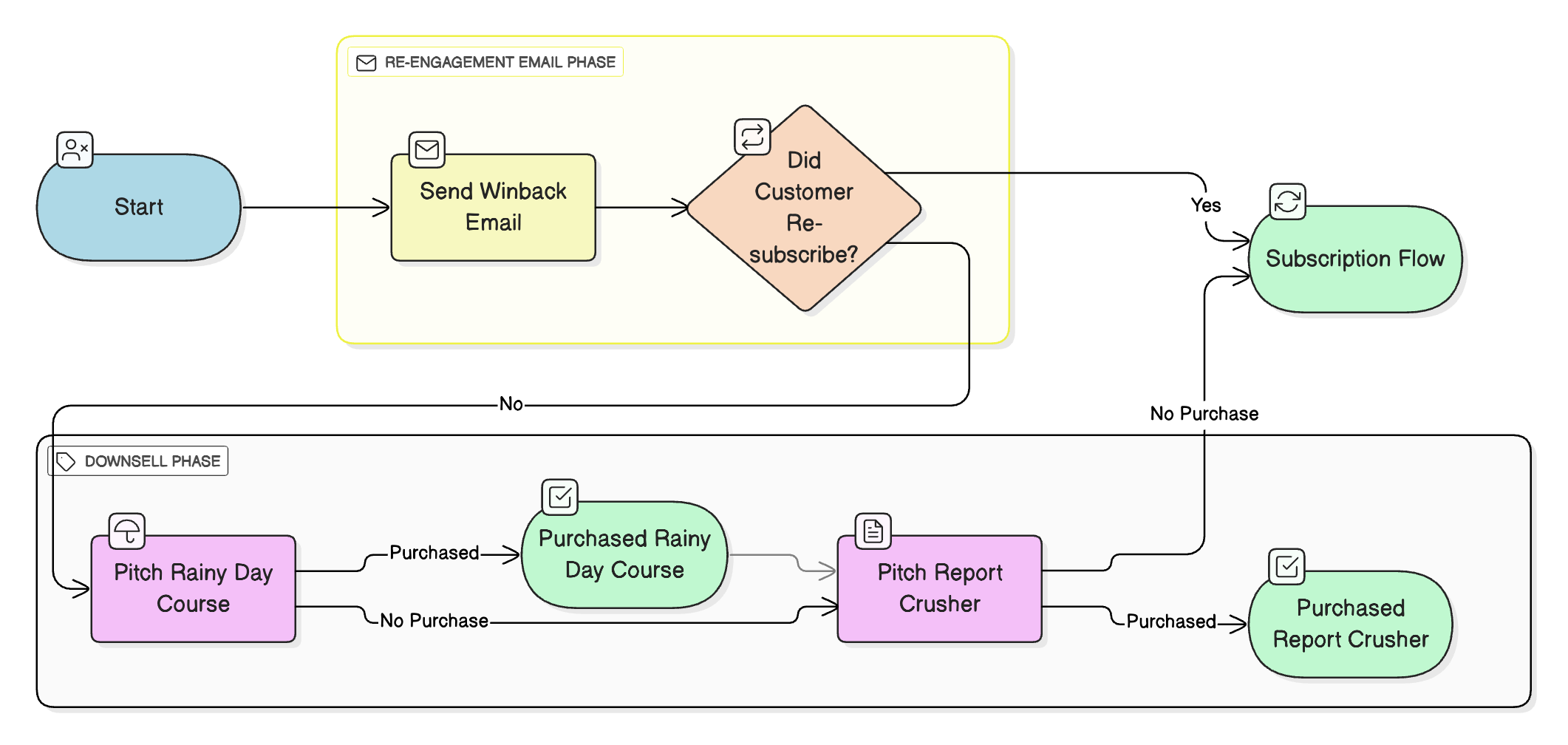
START: System flags a customer as inactive or lapsed.
STEP 1: Send "Winback" Email (Re-engagement offer).
DECISION: Did they re-subscribe? IF YES: Route back to [Subscription Flow]. IF NO: Attempt downsell.
STEP 2: Pitch "Rainy Day Course."
STEP 3: Pitch "Report Crusher."
END: If no purchase, move to inactive archive.
Rainy Day Completionist
Report Crusher Completionist
4.7. Static Media Assets
4.7.1. Definition
Creative images, videos & graphics that will be used on our websites, social platforms and as downloadable assets from our web platform.
4.7.2. Comprised of
-
customer journey map
-
certificates
-
report crusher
-
rainy day
-
-
health test
-
workbooks
-
images
-
video courses
-
ads
-
graphic overlays
-
show formats (wireframes)
-
software mockups (user stories)
4.7.3. How we will build it
Product Definitions
1. MIFGE
| Azure Blob Directory→ project_pain/MIFGE_source_material/ |
1.1. Definition
-
MIFGE = most incredible free gift ever. This is our lead magnet, the irrestible package that makes it a no brainer for people to join our ecosystem.
1.2. Comprised of
-
Health Test
-
Report Backlog Lite (handout)
-
Prioritization (Next Steps)
-
Octupus Lite
-
Hot Seat
1.3. How we will build it
-
Maidie to compile a list of the source documents and place them in the above Azure blob directory
-
Maidie will work on generating the
liteversions with Joe’s feedback / in working sessions
1.4. upsells 💎
1.5. cross-sells 💰
n/a
2. Rainy Day
2.1. Definition
Rainy Day is a low-cost, entry-level product designed to address the concern:
What if I lose the person who handles my reports?
It provides a straightforward way to document current reporting processes, making them repeatable and recoverable, even if key personnel depart. It serves as a "backup system" or "parachute" for informal or person-dependent reporting setups, while introducing users to the broader Report Factory ecosystem.
2.2. Comprised of
-
6–10 short prerecorded video modules (total duration well under 6 hours)
-
Checklists and handouts (light versions of core materials)
-
Documentation templates
-
Guided process for backing up and documenting existing reports
-
Final submission for “Watertight Certification” (automated or light review)
-
Digital badge + certificate upon completion
-
Immediate upsell sequence to Report Crusher and $99/month community
-
Price point: $59–$129 one-time (positioned as high-value, low-cost entry)
-
Workbook
2.3. How we will build it
2.3.1. structure
-
Begin with live sessions to test and refine content, then transition to fully prerecorded videos for scalability.
-
Develop 6–10 core video modules focused on deep dives into
-
backup procedures
-
repeatability
-
documentation
-
-
Create 3–5 supporting handouts and templates as light versions of proven materials
-
Record short promotional segments (30-second and 2–5-minute spots) for use in ads and within the course.
-
Structure the course to end with
-
certification
-
upsell opportunities
-
referrals to higher-tier products (e.g., Report Crusher inclusion for triage cases).
-
2.3.2. Content Delivery
Use initial live deliveries to capture real-world insights, refine content, and build a self-liquidating offer that funds acquisition while funneling users upward.
2.3.3. ads
-
Facebook Marketing ads
-
30 second spot
-
-
Intra-Course
-
2-5 minute upsell spot
-
2.4. upsells 💎
2.5. cross-sells 💰
2.6. target margin
break even
3. Report Crusher
3.1. Definition
A 5-day live (or hybrid recorded) intensive workshop delivered weekly. The program is designed as a high-energy, engaging onboarding experience for individuals and teams at any skill level—beginners who have never built reports, intermediates seeking consistency, and advanced users looking to refine repeatable systems. It serves as a primary vehicle for participants to complete real-world reports while learning structured Report Factory principles.
3.1.1. Key Objectives
-
Enable participants to complete 1–4 priority reports they must deliver in their business.
-
Provide step-by-step guided implementation, modeling best practices in report development, data connection, security, visualization, and deployment.
-
Demonstrate the end-to-end process of creating professional, repeatable reports, regardless of the platform (e.g., Power BI, Tableau, Domo).
-
Incorporate live "hot seat" sessions where individual challenges are addressed in real time.
-
Showcase AI tools (
Joe’s Nice Robots) for experimentation and problem-solving during development. -
Build participant confidence by creating a supportive, non-judgmental environment where questions are encouraged and peer knowledge is shared.
-
Collect community-driven quick-start checklists, blueprints, and solutions to enrich the broader knowledge base (and potentially feed Report Market)
3.2. Comprised of
-
Self-paced digital courses (Rainy Day / Waterproof) – often included as a mini-module or bonus for documentation and backup principles.
-
Core live 5-day Report Crusher Challenge – the flagship intensive.
-
Subscription community + coaching ($99–$120/month) – hard-pitched during and after the challenge for ongoing support.
-
Multi-day paid workshops (Report Factory Workshop – $1,250+) – upsold as the next step for building comprehensive, failure-proof systems.
-
High-ticket implementation (Greenfield builds – $25k–$100k+) – positioned for custom, done-for-you solutions.
-
AI experimentation sandbox (Joe’s Nice Robots) – featured in hot seats as an upsell path to advanced implementation and Greenfield projects.
3.3. How we will build it
-
Daily 60–90 minute group sessions (typically mornings, live via Zoom).
-
High-energy facilitation with live demonstrations, modeling of report creation from scratch, and platform-agnostic guidance.
-
Participants bring 1–4 reports they must complete; progress is tracked across the week.
-
Step-by-step guided implementation using Report Factory principles (data connection, faking datasets for rapid prototyping, security setup, visualization, deployment).
-
Includes mini Rainy Day documentation module to ensure repeatability and backup.
-
Interactive elements: chat-based questions, peer-shared quick-start guides, hot seat troubleshooting, and AI-assisted problem-solving.
-
Breakout support: one-on-one or small-group slots available for immediate help (booked separately).
-
Community contributions: vacuuming participant expertise to build shared knowledge base (e.g., tool-specific checklists).
-
Hard pitch to $99/month community and upcoming Workshops/Report Factory events.
3.3.1. Content Delivery
-
Positioning as
the #1 onboarding platform for reporting in the US-
starts every Monday
-
suitable for new hires or team training
-
-
Price point: $297–$497
-
Live energy and enthusiasm to make participants feel supported and capable ("Isn’t this fun?").
-
Platform-agnostic approach: guidance on core principles, with community/expert input for specific tools.
-
Rapid prototyping encouragement (e.g., connect to Excel/Google Sheets for quick starts).
-
Post-challenge pathways clearly telegraphed
-
ongoing community
-
one-on-one advisory
-
tool-specific workshops
-
full system builds.
-
-
Future evolution
-
potential for participant "Minutemen" experts to assist in sessions, expanding capacity and community involvement.
-
3.4. upsells 💎
3.5. cross-sells 💰
4. Report Factory Workshops
4.1. Definition
Expert led workshops on industry specific processes for implementing many different technologies.
4.2. Comprised of
4.2.1. Data Modeling & Data Visualization
Workshop Schedule
-
Session 1
Time: 8:00 - 8:30 AM Topic: Data Visualization Tools Overview Details:

Power BI, Tableau, and Domo comparison
Data for people vs AI agents - understanding the difference
Reporting as operational intelligence foundation-
Session 2
Time: 8:30 - 9:00 AM Topic: Star Schema Design Fundamentals Details:

Star schema architecture and design principles
Dimensional modeling best practices
Data model as a company asset strategy-
Session 3
Time: 9:00 - 9:30 AM Topic: Medallion Architecture & Power BI Patterns Details:

Medallion architecture implementation
Power BI design patterns and best practices
Data layer optimization strategies-
Session 4
Time: 9:30 - 10:00 AM Topic: Hands-On: Creating Measures in DAX Details:

DAX language fundamentals for measures
Creating calculated columns and measures
Performance optimization in DAX-
Session 5
Time: 10:00 - 10:30 AM Topic: SQL Optimization & Placement Strategy Details:

Where to put the SQL - strategic placement decisions Strategic placement of SQL logic: source vs semantic layer
SQL vs DAX performance considerations
Query optimization techniques-
Session 6
Time: 10:30 - 11:00 AM Topic: Security, Governance & Compliance Details:

Data security and compliance frameworks
Security permissions and governance models
Row-level security implementation in Power BI
compliance standards (e.g., GDPR, HIPAA) - PHI/PII handling-
Session 7
Time: 11:00 - 11:30 AM Topic: Hands-On: Creating Power BI Reports Details:

Designing effective Power BI reports
Publishing and sharing strategies
User experience and accessibility considerations-
Session 8
Time: 11:30 AM - 12:00 PM Topic: 90-Day Action Plan & Report Backlog Details:

Creating your personalized 90-day action plan
Building your report backlog list
Data model implementation roadmap
Q&A and next steps discussion|
Workshop Summary Total Duration→ 4 Hours |
4.2.2. Data Plumbing
Workshop Schedule
-
Session 1
Time: 8:00 - 8:30 AM Topic: ETL Architecture Fundamentals Details:

Understanding ETL architecture patterns
Pipeline design principles and best practices
Data plumbing as operational intelligence foundation-
Session 2
Time: 8:30 - 9:00 AM Topic: Pipeline Tools & Technologies Details:

Snowflake, Fabric, and modern ETL platforms
Popular scripting languages for ETL orchestration (e.g., SQL, Python, Spark)
Tool selection and evaluation frameworks-
Session 3
Time: 9:00 - 9:30 AM Topic: Data Movement & Medallion Architecture Details:

Pipeline data movement strategies
Bronze, Silver, Gold refresh strategies for scalable data movement
Handling data transformations at scale-
Session 4
Time: 9:30 - 10:00 AM Topic: Hands-On: Designing Your Pipeline Details:

Step-by-step pipeline design exercise
Mapping data sources to business requirements
Creating your ETL architecture diagram using tools like Visio, Lucidchart etc-
Session 5
Time: 10:00 - 10:30 AM Topic: Exception Handling & Troubleshooting Details:

Designing robust exception handling
Troubleshooting common pipeline errors
Building monitoring and alerting systems-
Session 6
Time: 10:30 - 11:00 AM Topic: Security, Governance & Compliance Details:

Data security and compliance frameworks
Security permissions and governance models
Building RBAC matrices and lineage maps-
Session 7
Time: 11:00 - 11:30 AM Topic: Team Building & SQL Policy Details:

Creating comprehensive hiring and incentive plans
Developing SQL policy documentation
Building high-performing data teams-
Session 8
Time: 11:30 AM - 12:00 PM Topic: 90-Day Action Plan & Deliverables Details:

Creating your personalized 90-day action plan
Building your ETL backlog list
Finalizing architecture diagrams and documentation
Q&A and implementation roadmap discussion|
Workshop Summary Total Duration→ 4 Hours |
4.2.3. Next Steps F&O
4.2.4. Report Factory
4.2.5. Data Governance & Handling PII
4.3. How we will build it
4.4. upsells 💎
-
a
4.5. cross-sells 💰
5. Greenfield build
5.1. Definition
5.2. Comprised of
-
Greenfield Report Factory Build (custom ground-up engagements)
-
Joe’s Nice Robots (AI design-pattern jam sessions)
5.3. How we will build it
5.4. upsells 💎
-
a
5.5. cross-sells 💰
6. Monthly Subscription
6.1. Definition
6.2. Comprised of
-
$99/month Report Factory Insider Community (bi-weekly hot seats + resource vault) === How we will build it === upsells 💎
-
a
6.3. cross-sells 💰
Domains
-
https://reportfactory.org – primary brand for the ecosystem and community
-
https://conduitbi.com – professional services and consulting arm
-
https://joesnicerobots.com or @JoesNiceRobots on X (planned AI playground handle)
Planning
1. 2026 rules of engagement
-
focus on one track at a time as much as possible (i.e. Nico / Maidie)
-
SMB Q1→SMC
-
-
Meetings are for BUILDING, not IDEATING into the future - if we want to do that let’s set a separate time for it and be explicit
-
all meetings result in adding to the documentation we’re looking at right now (AI summaries do not count)
-
no more
-
new concepts until we make a sale of Rainy Day or Report Crusher
-
discounts or special offers
-
-
start topical content in January - JRtN is good for exposure but it’s siloed
-
16 minutes and/or
-
Report Factory Podcast
-
| If we can’t build it in Q1 let’s cut it out of the plan and add it later. |
2. 2026 Q1 | Define →Build → Test → Launch
|
This quarter is dedicated to product development, platform setup, content creation, marketing asset preparation, and internal testing. We will assume no revenue-generating sales activities will occur. All products and the platform will be finalized and launched by the end of March 2026. |
2.1. Task Ownership
2.1.1. Choose a Domain → Joe
|
Due by January 1st, 2026 |
On what domain will the web platform run?
-
e.g.
app.reportfactory.org
2.1.2. Web Platform Development → Nico
|
Due by March 31st, 2026 |
| Feature | Details |
|---|---|
Auth |
Login system. Authorization system (who am I? what can I do?) |
Profile Page |
Manage / upgrade subscription plans, password, email & preferences |
Shop |
Stripe integration. Build sales pages, checkout flows, and upsell sequences for Rainy Day, Report Crusher, etc.. |
Automated Emails |
Based on customer state i.e. bought this but not that / no transactions in x days etc.. triggers email sequences |
File Storage |
Azure Blob Storage for static/downloadable assets |
Embedded Video Course |
Simple middleware to paywall access to embedded videos hosted on YouTube (unlisted) |
Chat Forum |
simple thread based interactive forum to drive engagement / answer questions / drive positive reviews |
2.1.5. Report Crusher Challenge → All
| Film & Audio | Editor | Content |
|---|---|---|
Nico |
Maidie |
Joe/B&B |
| What is Report Crusher? |
2.1.6. Email Sequences → Nico
|
Due for review by February 28th, 2026 |
2.1.7. Landing Pages → Nico
|
Due for review by March 15th, 2026 |
2.1.8. Report Factory Podcast → All
| Social Outbound | Primary Driver / Editor | Content |
|---|---|---|
Nico |
Maidie |
Joe |
|
First episode due January 31st, 2026 |
2.1.9. 16 Minutes → All
| Social Outbound | Primary Driver / Editor | Content |
|---|---|---|
Nico |
Maidie |
Joe |
|
First episode due January 31st, 2026 |
2.2. Expected outcome
-
Fully operational product ecosystem with supportive content ready for Q2 revenue ramp.
3. 2026 Q2 | Initial Launch and Trial by Fire 🔥
Focus on driving traffic, acquiring customers, and optimizing self-liquidating offers. Begin paid advertising to test lead magnets and low-ticket entry points (MIFGE/free → Rainy Day → Report Crusher). Run initial live Report Crusher cohorts. Establish baseline conversion metrics.
3.1. Tasks
-
Launch paid ad campaigns (Facebook/LinkedIn) targeting Rainy Day and lead magnets (~$200,000 budget allocation).
-
Run 4–6 live Report Crusher Challenge cohorts (weekly or bi-weekly).
-
Activate $99/month community with initial members from upsells.
-
Optimize funnels based on data: A/B test pricing ($59–$99 for Rainy Day, $297–$497 for Report Crusher), ad creatives, and email sequences.
-
Produce and distribute supporting content (Joe Reads the News weekly, podcast episodes, short clips).
-
Track key metrics: Customer acquisition cost, conversion rates, upsell performance.
-
Begin building evergreen elements (record best Report Crusher sessions for future automation).
3.2. Revenue target
-
$800,000 (20% of annual goal; focus on volume through low-ticket offers and early subscriptions).
4. 2026 Q3 | Scaling and Optimization Phase
Scale successful funnels, introduce evergreen components, and increase ad spend. Transition Report Crusher to hybrid (live + evergreen). Expand community features and begin testing higher-ticket upsells (early Workshops/Greenfield introductions).
4.1. Tasks
-
Increase ad budget (~$250,000 allocation) based on Q2 profitable channels.
-
Run 6–8 Report Crusher cohorts; launch first evergreen version.
-
Grow $99/month community (hot seats, resource additions, member case studies).
-
Refine self-liquidating offers to achieve breakeven or positive ROAS on ads.
-
Ramp up content production for organic traffic (podcast consistency, YouTube SEO-optimized tutorials).
-
Introduce limited beta Workshops or Greenfield teaser paths for qualified community members.
-
Analyze Q1–Q2 data to optimize pricing, messaging, and customer journey.
4.2. Revenue target
-
$1,200,000 (30% of annual goal; benefit from improved conversions and recurring subscriptions).
5. 2026 Q4 | Maturity and High-Ticket Expansion Phase
Maximize scale on proven funnels, fully automate low/mid-ticket paths, and emphasize recurring revenue + higher-ticket offers. Aim for strong holiday-season push and year-end momentum.
5.1. Tasks
-
Highest ad spend (~$250,000 allocation) targeting scaled profitable campaigns.
-
Fully evergreen Report Crusher + automated upsell sequences.
-
Expand community value (guest experts, advanced resources) to reduce churn and increase referrals.
-
Launch multi-day Report Factory Workshops ($1,250+ price point) for top community members.
-
Actively pitch Greenfield builds to qualified leads from community/hot seats.
-
Year-end campaign calendar execution (seasonal hooks, bundle offers).
-
Comprehensive performance review and 2027 planning preparation.
5.2. Revenue target
-
$2,000,000 (50% of annual goal; driven by recurring subscriptions, Workshops, and Greenfield closes).
6. 2026 Summary
-
Total revenue target: $4,000,000.
-
Total sales & marketing budget: $800,000 (allocated ~12.5% in Q1, 25% in Q2, 31.25% in Q3, 31.25% in Q4 to reflect ramp-up).
-
Primary revenue drivers: Rainy Day (entry volume), Report Crusher (mid-funnel conversion), $99/month subscriptions (recurring base), emerging Workshops/Greenfield (Q4 high-ticket).
-
Success metrics: Achieve positive or breakeven ROAS on ads by end of Q2; 30–40% upsell rate from Rainy Day → Report Crusher → Community; recurring revenue comprising ≥40% of total by Q4.
7. Reporting Targets
The reporting framework shall prioritize transparency, real-time decision-making, and alignment with financial objectives. All metrics must enable clear evaluation of marketing efficiency, funnel performance, and overall return on investment.
7.1. Core Principles
-
Topside reporting must always display: total spend on customer acquisition (advertising, content production, tools) versus total revenue generated from customer purchases.
-
If the system cannot clearly indicate whether a campaign, funnel, or iteration is profitable (positive, breakeven, or negative ROAS), it is considered incorrectly designed.
-
Primary question per iteration or campaign: "How much did we spend, and how much did we receive in return?"
7.2. Key Performance Indicators (Tracked Weekly and Quarterly)
-
Advertising spend and ROAS (Return on Ad Spend): Target breakeven or positive ROAS on self-liquidating offers (MIFGE/lead magnet and initial upsells) by end of Q2 2026.
-
Customer acquisition cost (CAC) by entry point (MIFGE/free lead magnet, Rainy Day direct).
-
Conversion rates across the funnel:
-
Lead magnet opt-ins to Rainy Day purchases.
-
Rainy Day completions to Report Crusher enrollments.
-
Report Crusher participants to $99/month community subscriptions.
-
Community members to higher-ticket offers (Workshops, Greenfield).
-
-
Revenue breakdown: One-time (Rainy Day, Report Crusher) versus recurring ($99/month subscriptions).
-
Lifetime value (LTV) projections based on observed upsell and retention rates.
-
Churn rate for $99/month community subscriptions.
7.3. Specific Targets Aligned to $4,000,000 Annual Revenue Goal
-
Achieve consistent tracking and reporting of spend-versus-revenue by launch in March 2026.
-
Self-liquidating offer (MIFGE + immediate upsells) to cover or exceed ad costs no later than Q2 2026.
-
Monthly reporting dashboard to include:
-
Cumulative spend (sales & marketing budget utilization against $800,000 annual allocation).
-
Revenue achieved versus quarterly targets (Q2: $800,000; Q3: $1,200,000; Q4: $2,000,000).
-
Funnel health metrics (conversion rates, average order value, recurring revenue percentage).
-
-
Google review optimization: Track completion-to-review conversion for all paid offers to support social proof and long-term trust signals.
All reports shall be designed for rapid iteration, enabling daily or intra-week adjustments to campaigns while maintaining a clear view of profitability and progress toward the annual revenue objective.
Jargon
| cross-sell is selling ancillary or complimentary items |
| upsell is selling an upgrade or more premium version of an existing item |