Reports are not boring, you’re boring.
| This document is a work in progress. |
Overview
This document seeks to define & encompass all components (and their nuance) regarding Project PLATFORM 2026.
|
What is Project PLATFORM?
|
Ultimately the goal is to launch into the SMC market with a new platform(Report Market) and marketing strategy. The below illustration is a high level relationship diagram of the involved components.
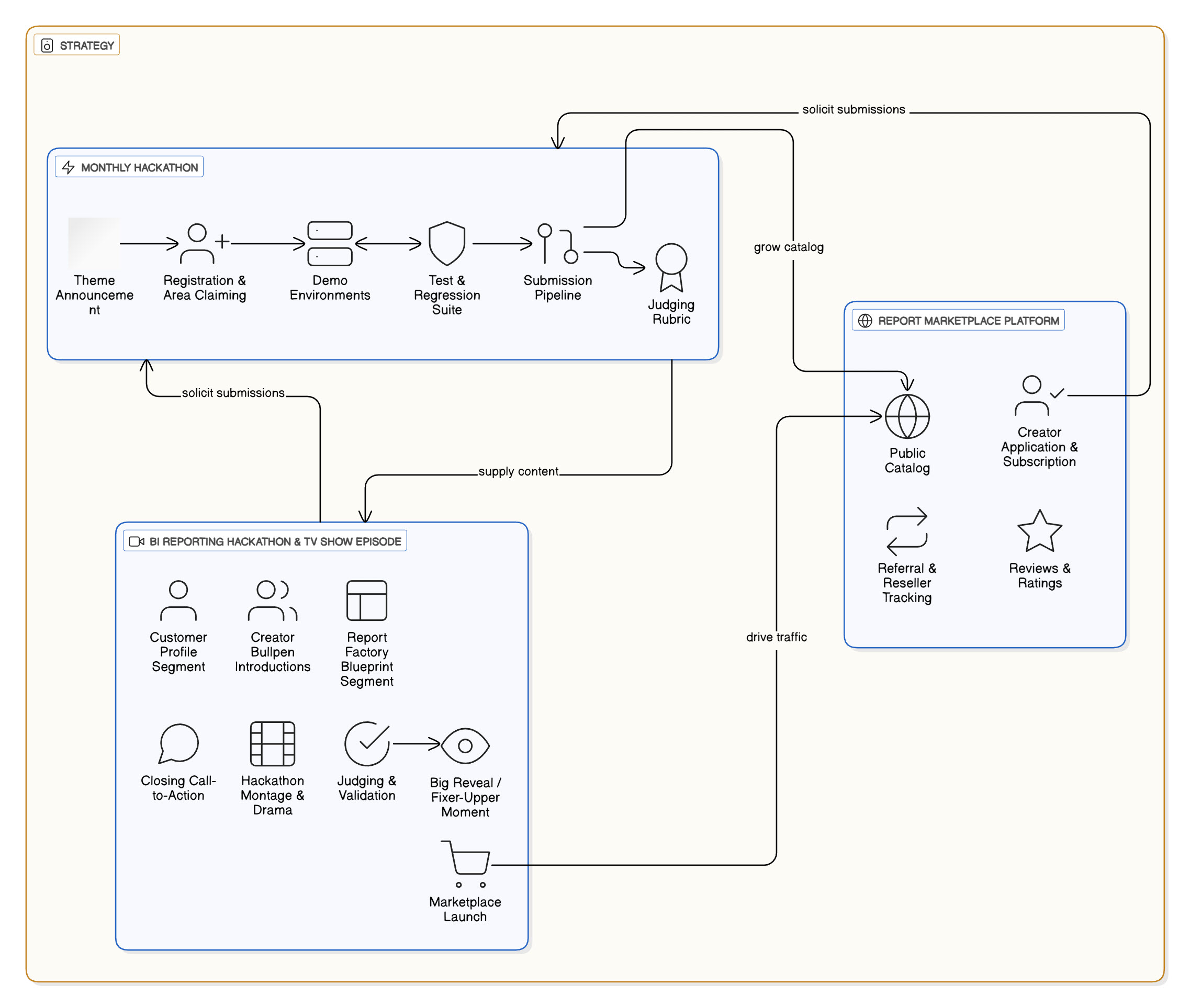
High Level Concepts
| This section will introduce the core ideas that will be referred to and further dissected throughout the rest of the document. |
1. Tiered Creator Platform for Microsoft Dynamics Reporting Solutions
-
Targeted at industries such as manufacturing, retail, and professional services.
-
Features a progressive creator journey with tiered subscriptions, advanced dashboards (analytics, attribution, API access), and dedicated support for sales, marketing, and IP vetting.
-
Emphasizes differentiation through hands-on assistance and power-user tools absent in competitors like Microsoft Marketplace.
2. On-Ramp Ecosystem to Microsoft Marketplace
-
Positions the platform as an entry point for creators, including independent consultants and resellers.
-
Includes GitHub integration, referral models, and a dedicated enablement program with AI-assisted mapping to facilitate listings on the Microsoft Marketplace.
-
Supports pathways from beginner creators to full Microsoft partners.
3. Community-Driven Content Creation via Hackathons
-
Employs gamified hackathons to generate and validate reporting solutions, allowing AI-assisted development with mandatory testing.
-
Fosters collaboration, attribution-based rewards, and community involvement to build a robust supply of vetted products.
4. Reality TV style marketing content
-
Centers on an entertaining episodic video series featuring real customer challenges, hackathon processes, creator profiles, and solution reveals.
-
Drives demand through customer wish lists, voting, and sponsorships while promoting the marketplace, partnerships, and educational content in an engaging, narrative format.
Marketing Strategy
1. Buyer Personas
1.1. Creator
-
Creators are individuals or entities who develop and publish BI/reporting solutions (e.g., data models, DAX measures, reports) on the platform.
-
Journey starts as beginners in remote regions, hosting products with low expectations, progressing to gaining traffic, sales, and attribution.
-
Needs include: basic dashboard with revenue, sales, products, conversion rates; advanced analytics (traffic sources, bounce rates, page views) as paid upgrade; API access for power users; export to CRM; sales trends analysis.
-
Higher tiers provide marketing/sales help, growth agents (AI-driven ops director for maximization), IP checks via AI agent.
-
Progression: upgrade subscriptions (e.g., $50 → $100 → $500/month) for more features; potential to become full Microsoft partners ($25,000/year) with additional benefits and advertising value.
-
Participation in hackathons to contribute, gain attribution, and earn revenue; can use AI but must test in demo environments.
-
Profiles highlighted in TV show format (e.g., bootstraps/rags-to-riches, pedigree, collaboration stories).
1.2. End User
-
End users are buyers of reporting/BI solutions, primarily in manufacturing, retail, professional services (sub-sectors like oil & gas, food services).
-
Seek low-friction purchases: quick, volume-based transactions without mandatory high-touch sales calls.
-
Opt-in options for contact: checkbox during checkout to allow seller contact, receive seller feeds, or hide information.
-
Benefit from public marketplace visibility for discovery; platform promotes solutions via SEO and open access (initially possibly gated for exclusivity).
-
Engage via hackathon-driven content: vote on wish lists/requests, pre-sign up for datasets, watch TV shows revealing solutions to real problems.
-
Receive value from competitive creator market, case studies, and ready-to-use datasets/reports at low cost (e.g., $500–$1,500 vs. traditional $40k–$500k).
1.3. Microsoft Partners
-
Microsoft partners are entities reselling, implementing, or extending solutions; can achieve high revenue (e.g., $10M/year) via deep integration.
-
Special tier: partner-focused dashboard (visually separated), API access, marketing/sales support, guidance on becoming/leveraging Microsoft partner status.
-
Featured in TV show/hackathons: provide pedigree solutions, collaborate on environments/setup, speak on behalf of clients.
-
Benefits: platform as on-ramp to Microsoft Marketplace (enablement program, form mapping, AI-assisted listing); referral credits for bringing customers.
-
Involvement in sponsorships, testing (e.g., regression automation), and ecosystem support.
1.4. ISVs
-
Independent Software Vendors (ISVs) develop and sell comprehensive solutions; treated similarly to advanced creators/partners.
-
Can resell/extend existing products (e.g., Conduit BI parts); participate in hackathons for attribution and sales.
-
Highlighted in platform ecosystem: contribute proven solutions, collaborate in competitive events.
-
Benefit from marketplace exposure, integration paths to Microsoft Marketplace, and community voting/requests.
2. Target Industries
-
Primary focus: manufacturing (e.g., plastics, food, inventory/costing challenges), retail, professional services.
-
Expandable to sub-verticals (e.g., oil & gas, food services, distribution/wholesale).
-
Platform supports broader ERP reporting (initially Dynamics 365 F&O, potential for SAP/Oracle via partnerships).
3. Go-to-Market Strategy
-
Core vehicle: monthly hackathons turned into reality TV-style show (e.g., "Reporting Makeover" or playful branding like "Joe’s Nice Reports").
-
Format: profile customer problem → report factory blueprint → creator bullpen/hackathon → big reveal; includes segments on customer pain, factory standards, creator stories.
-
Demand generation: customer wish list/submissions, voting (by persona type), pre-sign ups; select top requests for episodes.
-
Supply generation: creators compete in defined areas (e.g., ETL, DAX); winners gain attribution/payment/notoriety.
-
Promotion: YouTube/episodic content, sponsors (e.g., Leapwork for testing, MCA Connect for solutions), partnerships for environments/AI.
-
Marketplace: open (for SEO/visibility), low-friction sales; MVP via reselling existing assets (e.g., Conduit BI) and gamified hackathons.
-
Differentiation: entertainment value, competitive creator market, IP/agent support, Microsoft Marketplace enablement program.
Products
1. report market
1.1. data models
1.2. conduit BI
1.3. power BI templates
1.3.1. conduit BI
1.4. excel templates
1.4.1. 13-week cash
1.5. queries and stored procedures
1.6. ARM templates
1.6.1. conduit BI tech only
Guiding Internal Principles
1. Product Development
-
Prioritize targeting industries such as manufacturing (e.g., oil and gas, food services), retail, and professional services, with further segmentation by sub-industries.
-
Establish tiered creator subscriptions: beginner level for initial hosting and sales; mid-tier for enhanced analytics, marketing support, and sales assistance; high-tier for Microsoft Partner benefits, including API access, advanced technical features, and dedicated operational guidance.
-
Implement AI agents to support creators, including IP conflict checks, growth optimization (acting as an operational director), marketing trends analysis, and assistance with Microsoft Marketplace onboarding.
-
Develop a marketplace enablement program to guide successful creators toward listing on the Microsoft Marketplace, including form mapping, AI-assisted setup, and potential integration pathways.
-
Introduce hackathons as a core mechanism for content creation: monthly or topical events where creators compete to build solutions based on customer-submitted challenges; winners receive attribution, payment, and sales revenue; submissions must be tested in demo environments.
-
Create customer intake processes for submitting reporting challenges via a wish list or application form; select high-vote submissions for hackathons to drive demand articulation.
-
Partner with entities (e.g., Microsoft partners, testing automation providers like Leapwork, consulting firms) for environment setup, regression testing, and sponsorships to support hackathon execution and platform scalability.
-
Gamify creator participation: allow AI usage with mandatory testing; provide templates, demo environments, and clear rules for claims on development areas (e.g., 30-day initial deadline with one 15-day extension upon demonstrated progress).
2. Producing Static Media Assets
-
Design visual maps and graphics for the platform and promotional content, such as an interactive "world map" of reporting domains (e.g., inventory, demand planning) for zooming into specific industries or challenges, inspired by detailed ecosystem visualizations.
-
Develop wireframes and visual elements for the creator dashboard, distinguishing Microsoft Partner views from standard creator views through unique design language while maintaining core functionality.
-
Create promotional graphics for hackathons, including motion elements, swoops, and thematic visuals (e.g., factory assembly lines, report blueprints on drafting tables) to enhance engagement.
-
Produce static assets for onboarding, such as explanatory videos or infographics for user registration types (e.g., creator, Microsoft partner, ISV, independent consultant, end customer, recruiter) and voting metadata.
-
Generate branding materials with a playful, approachable tone (e.g., humorous domain ideas like "Joe’s Nice Reports" or market analogies) to differentiate from formal tech naming conventions.
3. Producing Video Content
-
Launch a recurring video series in a reality TV-inspired format (target 30-45 minutes per episode) to promote the platform, structured around hackathons resolving real customer reporting challenges.
-
Standard episode segments:
-
Customer profile (industry, pain points, interviews; 2-5 minutes).
-
Report Factory blueprint session (architectural approach, standards advertisement).
-
Creator profiles (bootstraps/rags-to-riches, pedigree/established, collaboration stories).
-
Hackathon process (rules, timed development footage, drama).
-
Big reveal (solution demonstration, customer reaction, sales availability).
-
-
Include introductory narration highlighting the mission to make corporate reporting engaging and accessible.
-
Film on-location where possible (e.g., customer sites, simulated factories) or use AI-assisted production; start low-budget and scale to professional crew.
-
Feature sponsors, partners, and creators prominently for notoriety; end with calls-to-action for wish list submissions, creator registration, and marketplace purchases.
-
Produce supporting videos: short creator/onboarding explanations, case study teasers, and hackathon recaps for YouTube and platform embedding to drive traffic and community participation.
Our Target Partnership Scenarios
1. Microsoft Partnership
-
The platform is positioned as an "on-ramp" to the Microsoft Commercial Marketplace. Proposed collaborations involve integration (e.g., mapping listings from the platform to Microsoft’s forms), enablement programs to guide creators through Microsoft Marketplace setup, and joint promotion. This would bring marketing benefits such as increased foot traffic from Microsoft’s customer base and co-selling opportunities, differentiating the platform by offering better accompaniment than Microsoft provides directly.
2. Leapwork Partnership
-
Suggested for sponsoring or integrating automated regression testing automation. This could be featured in hackathons/showcases (e.g., zooming in on testing in the "report factory" map), with Leapwork providing resources or sponsorship to enhance solution validation and appeal to creators/customers.
3. MCA Connect Partnership
-
Highlighted for featuring their Inspire Platform and expertise in showcases/TV show formats. As a prominent Microsoft Dynamics 365 partner, they would be positioned as a "pedigree" example of high-quality contributions, providing mutual promotion and credibility.
4. Conduit BI and Report Factory Integration
-
Internal or close collaborations where Conduit BI provides initial templates, and Report Factory serves as the authoritative architecture/standard provider. These would be advertised heavily in video content and workshops to drive platform adoption.
5. Other Supporting Ecosystem Partners
-
Recommendations for partnering with marketing enablement firms, consultants (e.g., for operations/support), and vendors in areas like SMC marketing. Options include paid recommendations (vendors subscribe for visibility) or free endorsements to build trust. Independent consultants could act as resellers with referral credits.
-
Hackathon and Showcase Sponsors: Broader sponsorship model for events (e.g., "this week brought to you by…"), attracting companies to fund visibility in exchange for promotion during customer-focused hackathons and video productions.
Targest for $ & time (for cost and revenue), sequence, priority, roles/responsibilities.